Actress. Daughter. Comedienne. Buried at Mt. Olivet Cemetery in Salt Lake City, Utah.
Yesterday, April 19, 2026, I decided to take my (supposedly) daily walk at the Mt. Olivet Cemetery downtown. It’s an odd choice, I know—but I am a genealogist, after all. It’s a beautiful cemetery, an oasis in the middle of the concrete, with enormous old trees and a herd of deer you’ll often catch relaxing in their shade. I am fascinated by the imposing mausoleums built into the hillside, and row after row of unique upright stones that you no longer find in newer cemeteries because being able to mow efficiently eventually won out over graceful architecture and memento mori.
It was a gorgeous Sunday. Enough sun to burn the back of my neck and leave me with a tan line around my watch. Bees were out, the squirrels were squirreling, and a lone Canada goose followed me to my great-great grandmother’s grave, as if to oversee my ritual of gratitude. The painted rocks I left for Grandma Lillian last year and the year before were still there. I’m looking forward to Memorial Day, when I’ll add one more to the collection.
I walked slowly, not really there for the exercise as much as for the peace and time with my own thoughts. I remember thinking how good I felt. After a season of grief, losing my dad this year, I haven’t found myself so content since a camping trip last summer. It was a baptism back into the wonder and awe I usually carry for the world. As I crested a small hill, I found the deer herd—and came face to face with one lone doe standing on the outskirts of the rest who were lying like happy forest puppies under the trees. I startled her, and she startled me. Aware that she could come at me with a hoof to the face despite those big, doleful, innocent-looking eyes, I stopped in my tracks and averted my gaze so I wouldn’t seem like a challenge. There was a gravestone shaped like a bench next to me—what luck!—so I slowly sat down to watch the herd and take in the vitamin D.
After a moment I started to feel sad.
After two moments, I realized this was more than just sad. It was whole-body emotional pain. I felt like I was imploding, sucking inward like a black hole of despair. My shoulders crumpled, I wrapped my arms around my middle, and as tears reached my eyes I thought to myself, “this is not my grief.” I had been so at ease a moment ago, and there was no conscious thought in my mind that would have brought this feeling. I wasn’t thinking of my dad’s death, or my own; I wasn’t even considering the hundreds of graves near me as reminders of human fragility. It hit me like a curtain of rain, and everything in me said the feeling wasn’t mine.
Whose despair was this, then?
I paused. I took a few breaths. I tried to focus on what I was feeling, and what thoughts came to mind. After a beat, I felt like it was a woman. I imagined her sitting next to me on the bench, reaching her hand out to hold mine. She was… incredibly lonely. And the despair was in being forgotten. No one visited her grave, no one knew her name. I let the tears fall for this perhaps imaginary woman, and then I wondered if there was any way I could figure out who she was. I stood up, the deer now forgotten, and looked over the graves in my line of sight, waiting to see if a name jumped out at me.
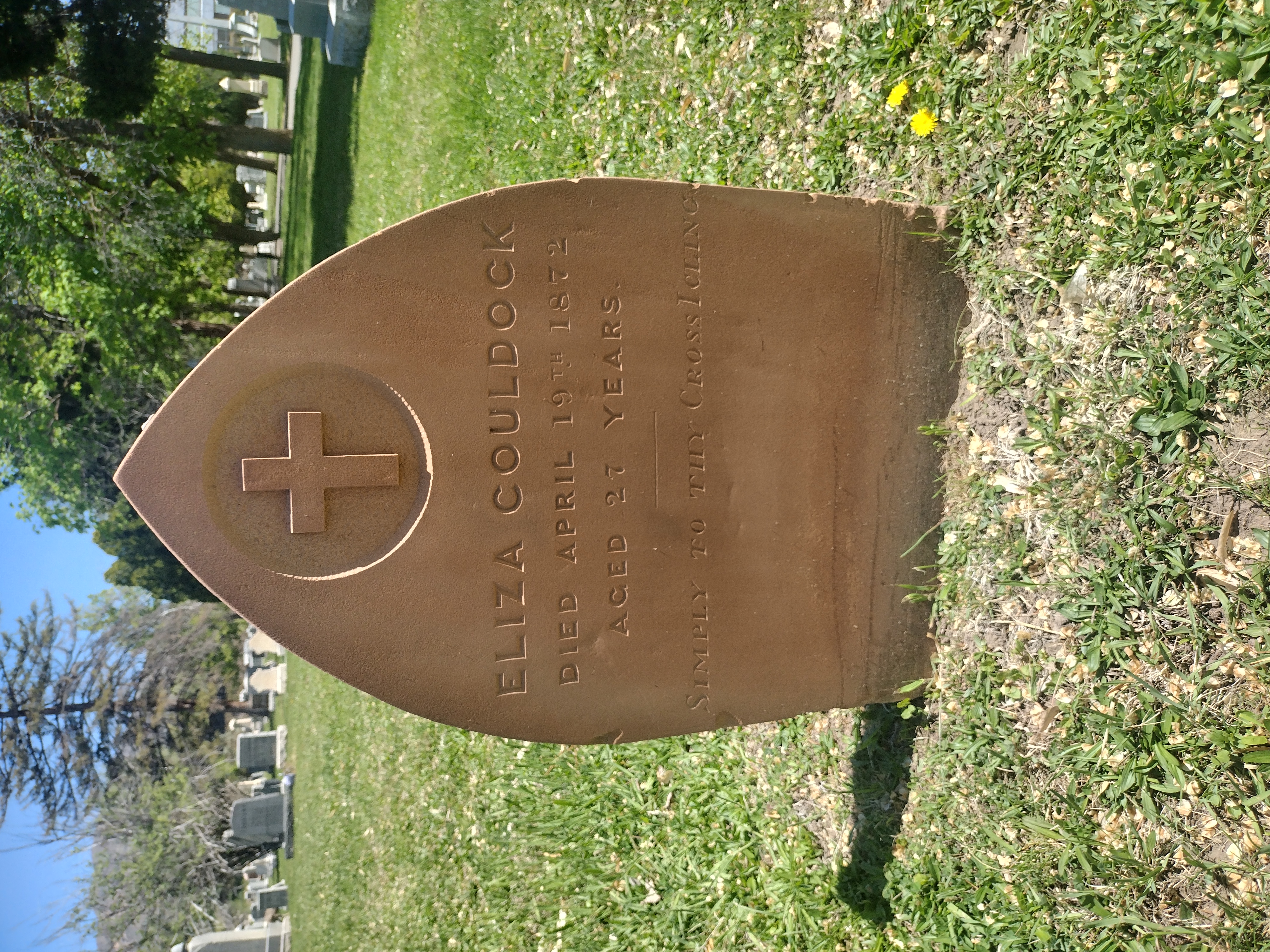
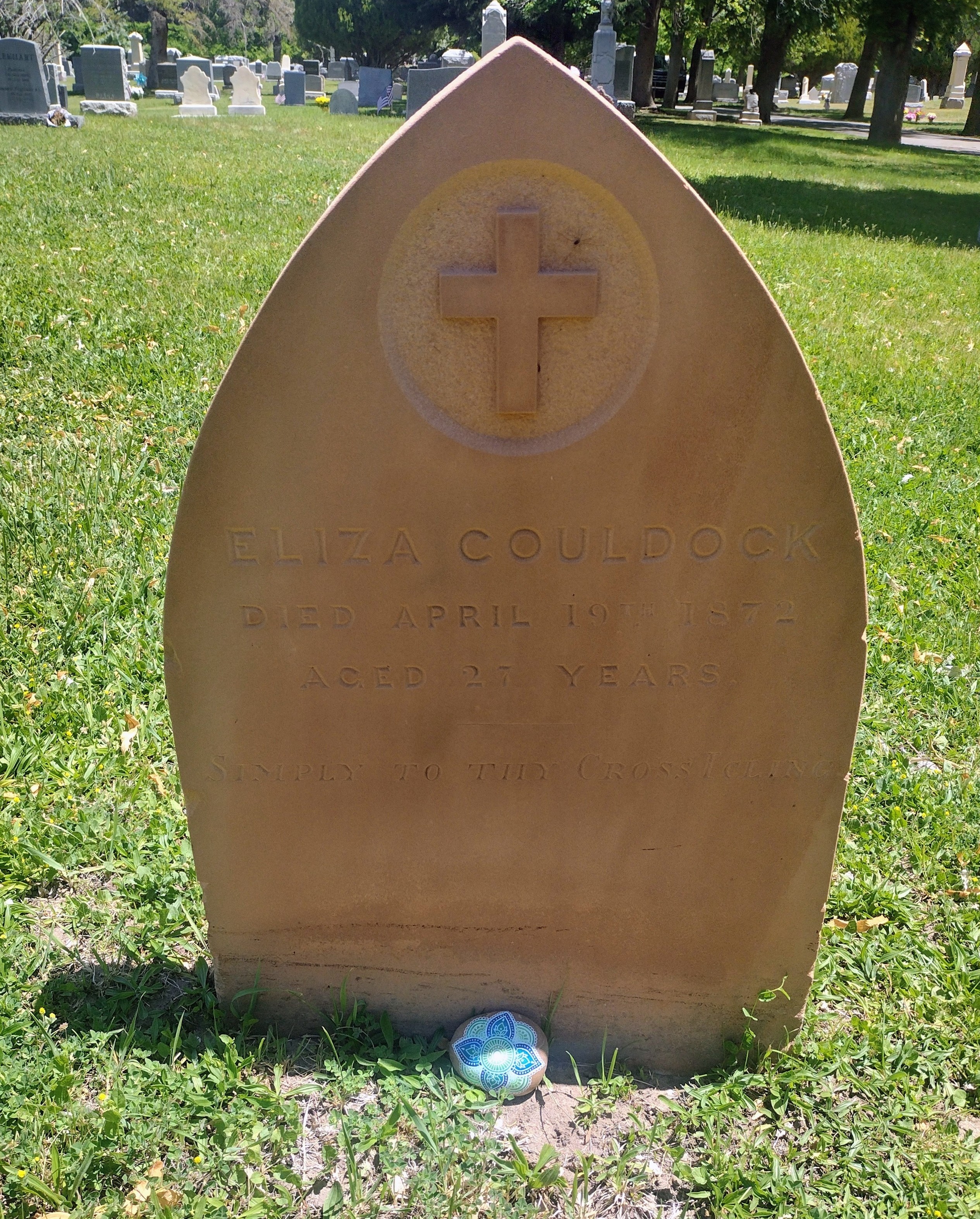
Right in front of me and to the left, closest to where my invisible new friend had sat, was a pink sandstone grave marker, plain but with clear letters: ELIZA COULDOCK, aged 27 years.
Eliza Couldock’s gravestone at Mt. Olivet Cemetery.
Eliza?
The other graves around me faded into the ether, the white and grey of their stones a bland backdrop to the rosy clarity of Eliza’s. I snapped a photo of it and vowed to go home and find out who she was, why she died so young, and perhaps why she was so forlorn.
I started back towards my car, now with a mission, and while I walked I zoomed in on the photo for more clues. It was only then that I looked at the date of death: April 19, 1872.
I looked at the date in the corner of my phone: April 19, 2026.
I may have said a bad word to the audience of the dead.
I couldn’t even wait to get home. I sat in my car and pulled up her Find a Grave listing and read this description: “Eliza was an actress of some note, appearing often with her father, C.W. Couldock, who was a well-known and popular actor during the 1800's.”
“An actress,” I breathed. She suddenly made so much sense.
As an actress myself, nothing would make me sadder than being forgotten. The rush of applause, knowing you made someone feel something, holding the attention of a hundred people at once—and then the curtain of death falling, permanently. No curtain call. It would indeed feel like a black hole of despair.
Say no more, Eliza. I will remember you, and I will tell everyone I know who you were:
The Actress
Eliza Couldock was born around 1842 or 1843, probably in Bristol, England, the daughter of actor Charles Walter (C.W.) Couldock and Louisa Smith. Her gravestone says she was 27 when she died, but earlier records suggest she was closer to 29.
C.W. left England for the New York stage in 1849. The following May, seven-year-old Eliza crossed the Atlantic aboard the Cambridge with her mother and baby brother. By September, the family was living in New York City.
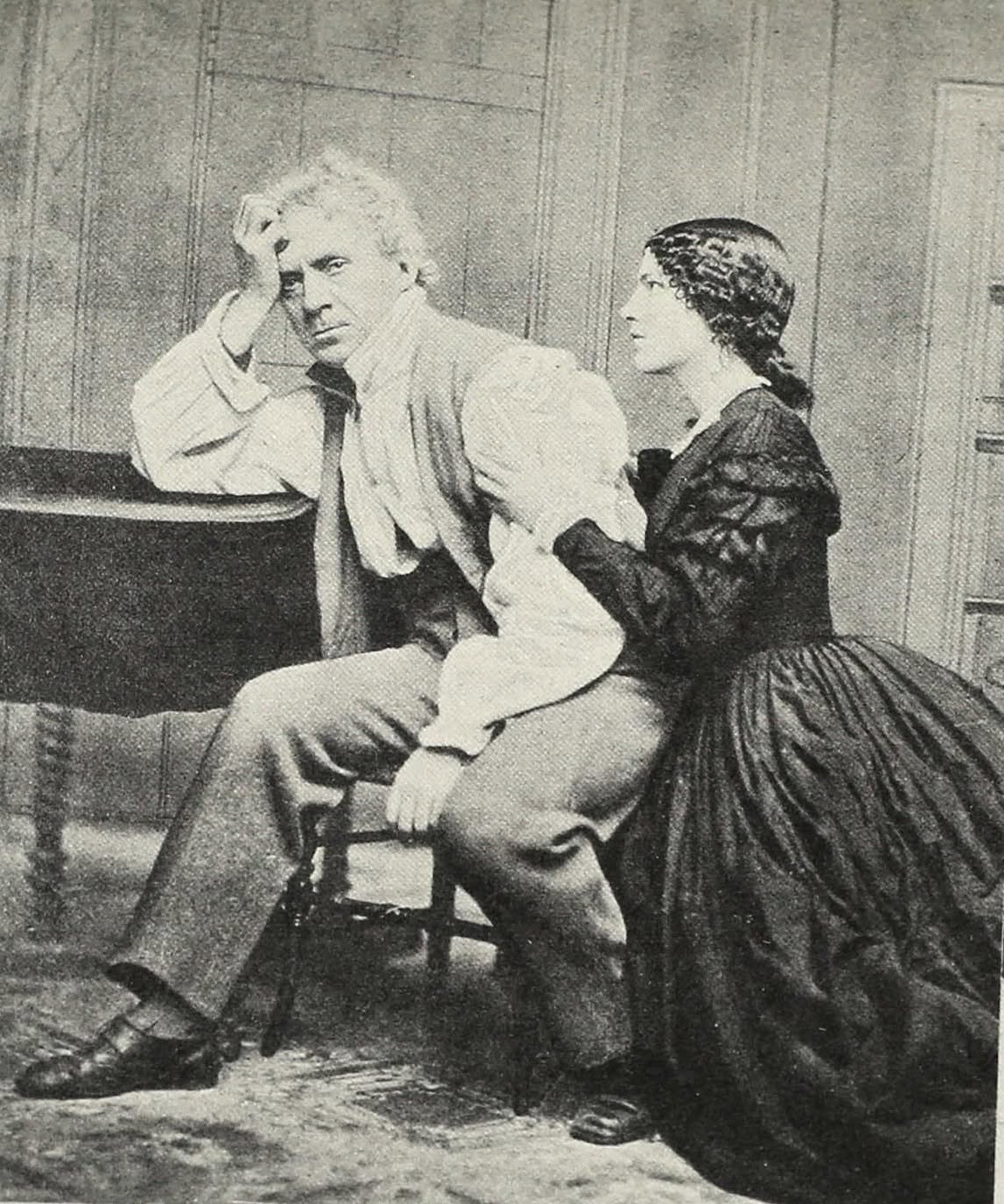
C.W. Couldock and his daughter Eliza.
Eliza grew up in the theater. She first appeared onstage in Pittsburgh at around twelve, and by seventeen she was performing with her father at Laura Keene's Theatre in New York. In May 1859, she played Titania, Queen of the Fairies, in A Midsummer Night's Dream.
By the 1860 census, C.W. gave his occupation as “tragedian.” Eliza, still a teenager, was a “comedienne.”
And she really was funny.
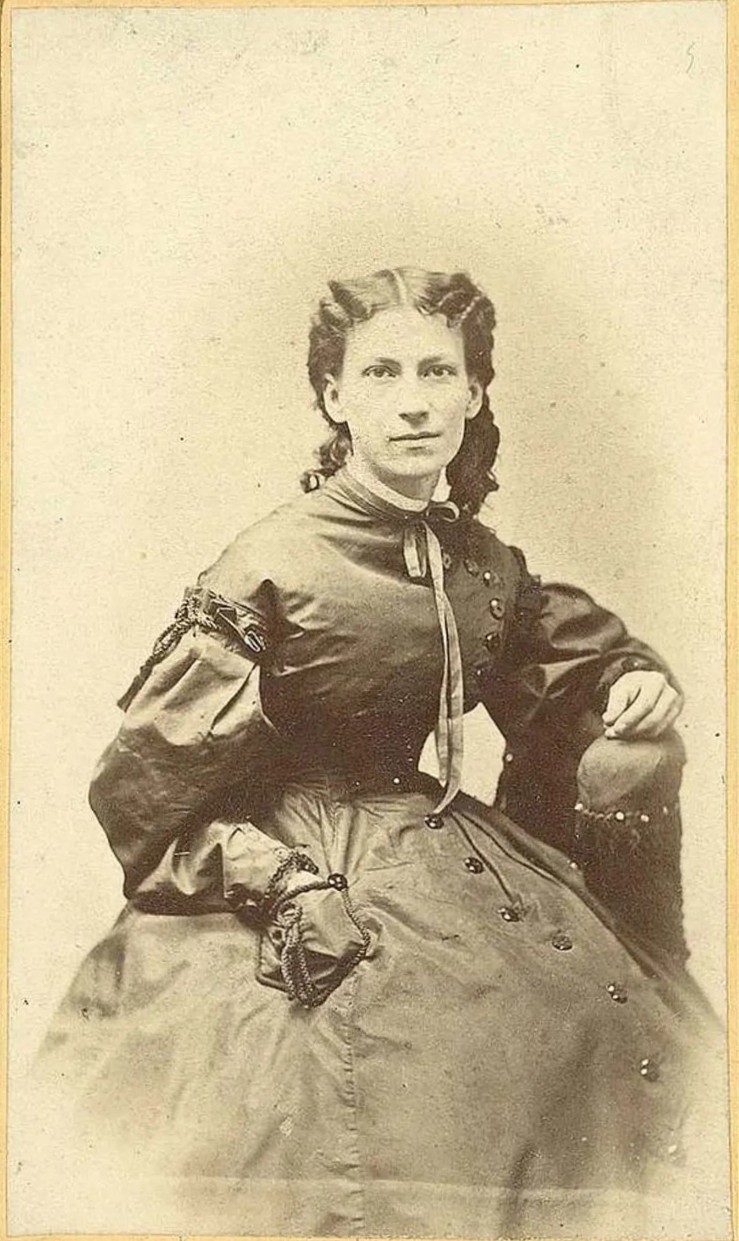
The famous Victorian-era actress Clara Morris, who knew the Couldocks, wrote that the other actors were “always pleased” when Eliza accompanied her father. Morris remembered Eliza’s brilliant hazel eyes and said she strongly resembled her father. She also declared that Eliza “of course could not be pretty,” an assessment I will allow readers to evaluate for themselves. But she described Eliza as “well read, clever, and witty,” with a sharp sense of humor.
Eliza was also apparently very good at winding up her overly dramatic father for the entertainment of everyone around them. Morris recalled one occasion when Eliza encouraged an acquaintance to ask C.W. about California, knowing perfectly well that he had strong feelings on the subject. After the resulting tirade, Eliza calmly smoothed her father’s hair and remarked, “Pa’s always so emphatic about California.”
I like this woman already.
The Show Must Go On
Brigham Young had the Salt Lake Theatre built in 1861, and it was considered one of the finest theaters in the West. Touring actors regularly passed through its doors, including the Couldocks.
Sometime in late 1871, Eliza halted her touring schedule and stayed behind in Salt Lake City while her father returned east. According to actor John S. Lindsay, who knew and performed with her, she remained there to recuperate from poor health.
Apparently, Eliza had an interesting definition of the word recuperate.
She settled right into Salt Lake's theatrical community. And she was busy. Between November and March, newspapers advertised her in literally a dozen different productions, back to back to back.
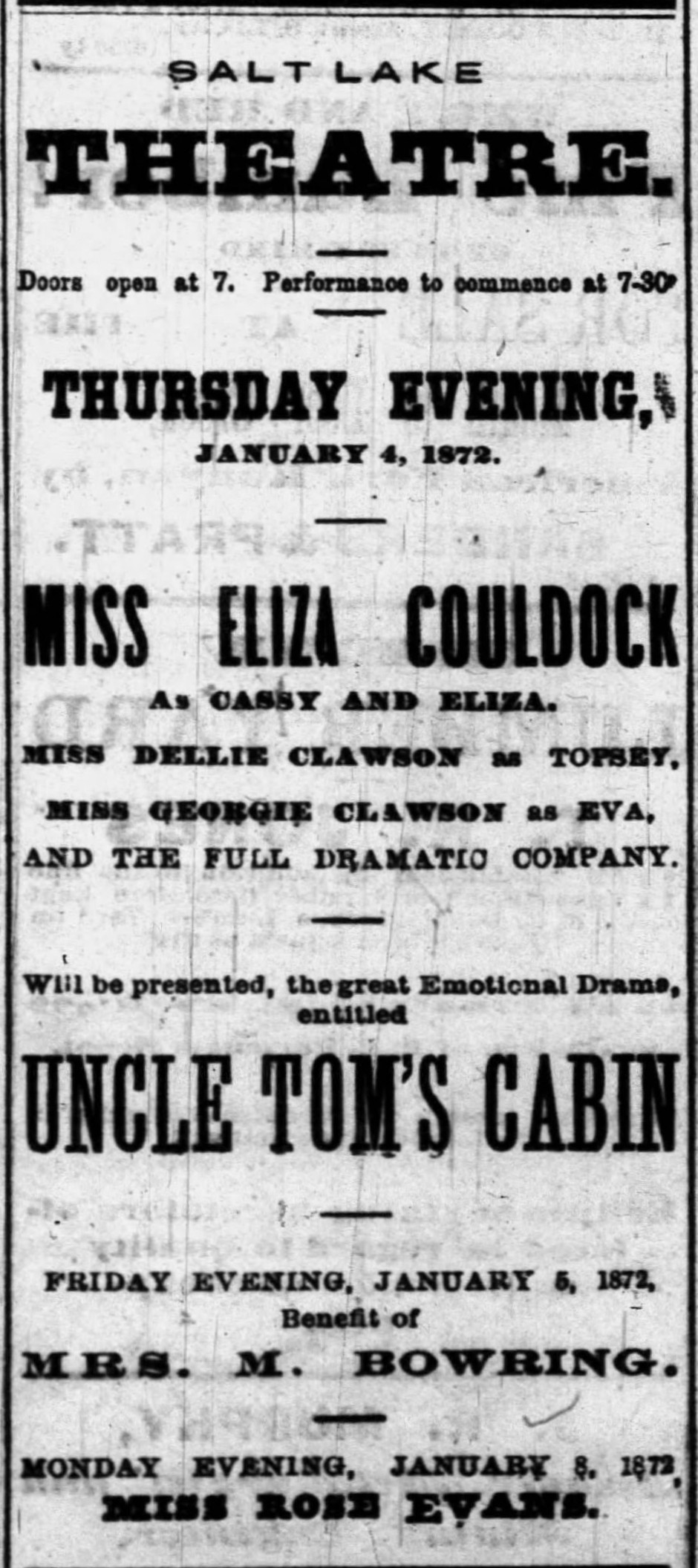
In early January 1872, Eliza played both Cassy and Eliza during a week-long engagement of Uncle Tom's Cabin. Lindsay, who performed with her, later remembered that she was already “nervous and poorly.” He described her as “over ambitious” and said she “worked beyond her strength.”
Eliza Couldock was advertised as both Cassy and Eliza in
Uncle Tom’s Cabin at the Salt Lake Theatre in January 1872.
Lindsay remembered Uncle Tom's Cabin as Eliza's last appearance onstage, but Salt Lake newspapers tell a different story. On January 22, she played the Queen in Hamlet. Five days later she played the title role in Mary Price and appeared in Daughter of the Regiment on the same night. Sh performed in multiple different shows through February and into March. On March 16, she appeared as Louise in Frou-Frou.
I have done enough community theater to have two pressing historical questions:
How the hell did this woman remember all her lines?
And how the hell did she keep doing it while she was sick?
On April 9, a Salt Lake newspaper announced that Eliza Couldock was dead.
Except… She wasn't.
The report described her as having suffered severely from pneumonia “for some time past,” adding that her constitution had been undermined by “exhaustive application to her profession.” Somehow the erroneous information was telegraphed east, and newspapers around the country began reporting her death while Eliza was still very much alive.
The next day, the Deseret News issued a correction. Eliza was seriously ill at the home of Henry McEwan, it stated, but “last night she was able to sit up in bed.”
Another report that day called her stronger and apparently better, though her eyesight, which had been “quite dim,” had only somewhat improved. By April 13, the news was better still: she was strong enough to leave her room for a short time.
Reports of Eliza's death had been greatly exaggerated.
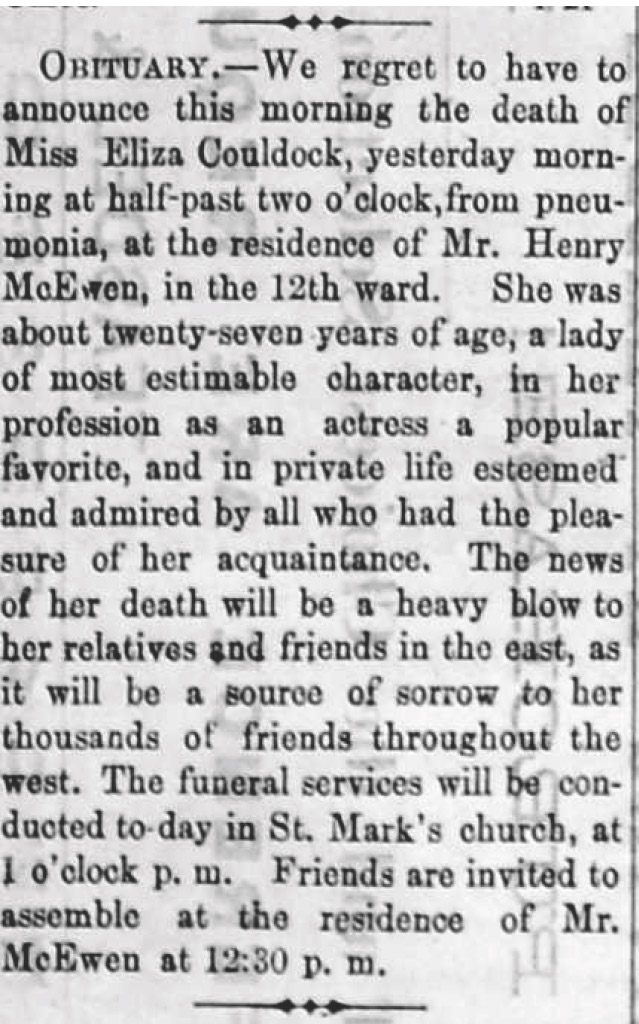
The good news was short-lived, however. Six days later, at 2:30 in the morning of April 19, Eliza Couldock died.
The Salt Lake Herald newspaper announcement of Eliza’s death on April 19, 1872.
The newspapers attributed her final illness to pneumonia, while Utah's death register recorded her cause of death as consumption, the 19th-century name commonly used for tuberculosis. One obituary said her health had been declining for several months, before her illness became dangerous only a few weeks before her death.
Whatever the exact shape of her ill health, Eliza had apparently continued performing through at least part of that decline. I keep thinking about how exhausting it must have been. The lady had an iron will.
Her Father Was Not Among Them
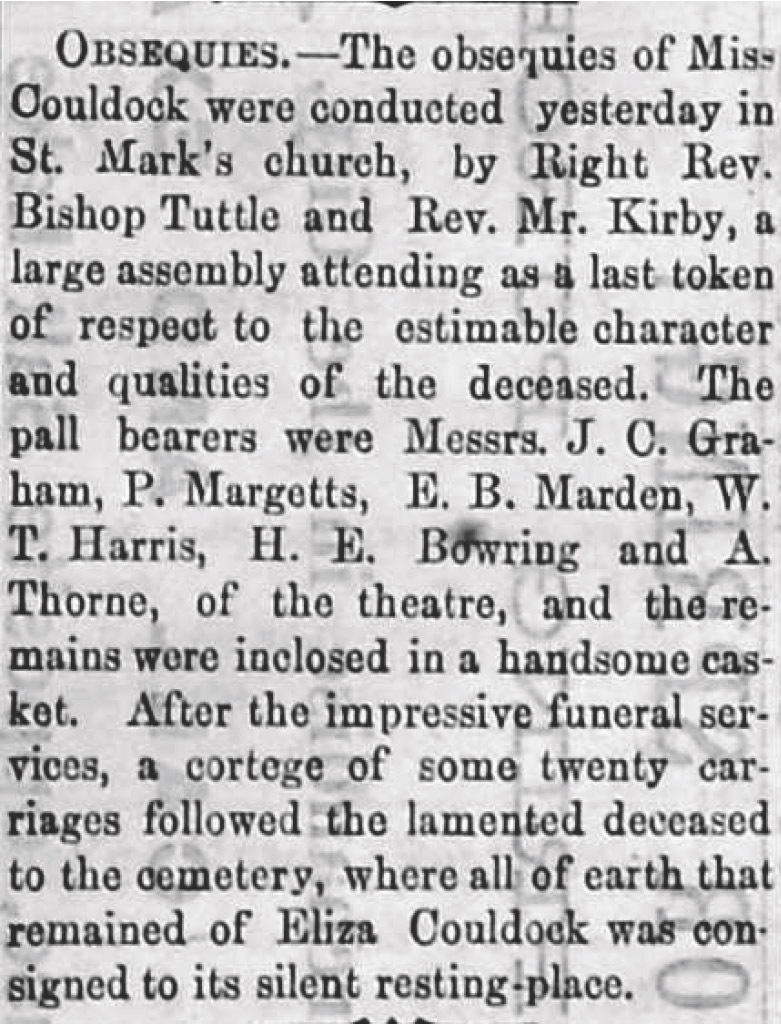
The Deseret News reported on Eliza's funeral on April 20. A large gathering attended her service at St. Mark's Church, most of them fellow actors and members of the Salt Lake Dramatic Association. Six men from the theater served as pallbearers, and afterward, a procession of twenty carriages followed her casket to the cemetery.
Eliza’s funeral drew fellow actors, members of the Salt Lake Dramatic Association,
and a procession of approximately twenty carriages.
Her father was not among them.
C.W. was more than two thousand miles away in Philadelphia.
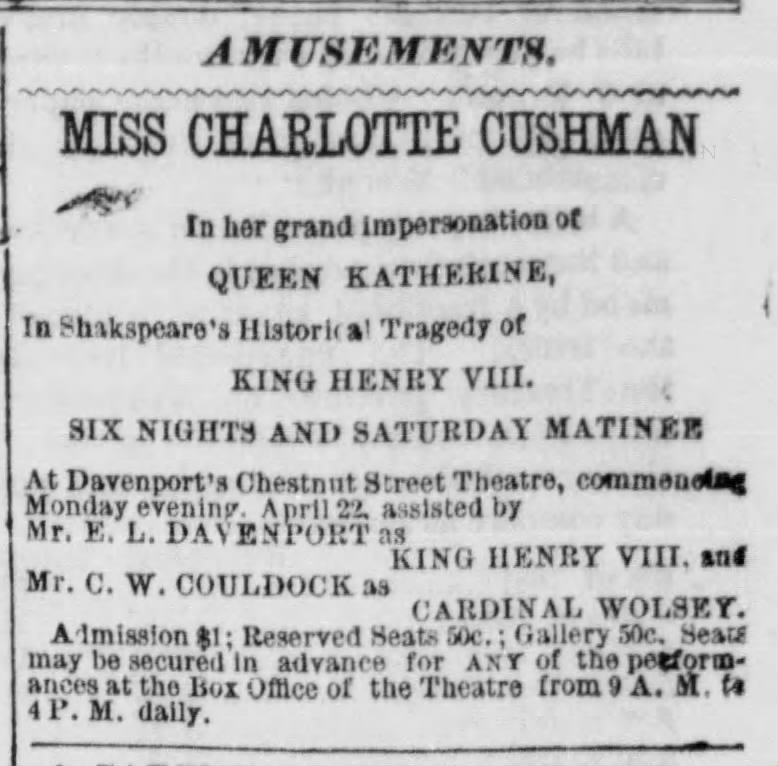
When he left Eliza in Salt Lake City, he went back east for other engagements he was booked for. By the following spring, he was already committed to a production of Henry VIII, hired specifically to reprise his celebrated portrayal of Cardinal Wolsey. The show, and his appearance in it, had been advertised before Eliza's death. He was locked in.
C.W. Couldock was already being advertised in Philadelphia for his appearance
as Cardinal Wolsey in Henry VIII when Eliza died in Salt Lake City.
There was no airplane to catch, no refrigerated morgue where her body could wait for him. Even by train he could never have made it there and back again in time. Eliza was buried the day after she died, without her beloved father.
Three days later, he walked onto a stage in Philadelphia.
The reviews were brutal.
One correspondent described C.W. as “entirely broken-down.” Another criticized the “heavy laboriousness” of his performance. Still another called him “lamentably bad.” It was monstrous to read the reviews! His daughter had been dead less than a week, and he had been unable even to attend her funeral. Even the best costume can’t cover grief like that. But both he and Eliza knew: the show must go on.
It makes me feel a little less lonely for her to know that reports after the fact said whenever her father returned to Salt Lake, he never failed to visit her grave.
She Became So
Eliza's mother died in 1877. She had five younger siblings, but four died very young. Her surviving brother lived out his life in New York. Her father died in 1898, and all the visits to her resting place died with him.
A May 1895 article in Harper's Weekly wrote of her father, “If there is any adult American who does not know Charles Couldock, it must be a resident of some very remote place.” Eliza was the daughter of one of America's most famous actors. But she was not merely his daughter. Her own performances were advertised across the country. When she became ill, newspapers tracked her condition; and when she finally died, the news appeared across the United States and as far away as Canada and England.
Eliza Couldock was not unknown.
But she became so. Her spotlight went out. The playbills were discarded. The people who had known her grew old and died, and eventually the applause stopped echoing.
Until a fellow actress, one familiar enough with grief to know it when she felt it, sat down on a gravestone bench on the 154th anniversary of her death.
Standing Ovation
Please accept my standing ovation, Eliza, and know that your star hasn't gone out completely. Your life and your story mattered. And while I only felt you yesterday, today I see you.
The Rock
I painted a memorial rock for Eliza and left it at the base of her gravestone
in the Mt. Olivet Cemetery on Memorial Day, 2026.
Eliza’s rock among the Memorial Day stones.
The rock placed beneath Eliza’s gravestone at Mt. Olivet Cemetery.
Records That Returned Eliza
Eliza Couldock Arrives in New York
Seven-year-old Eliza Couldock arrived in New York on May 17, 1850, aboard the
Cambridge from Liverpool. She traveled with her mother, Louisa,
age 28, and her one-year-old brother, Charles.
Source: Ancestry.com, New York, U.S., Arriving Passenger
and Crew Lists (including Castle Garden and Ellis Island), 1820–1957;
passenger list for the Cambridge, arrived New York 17 May 1850;
National Archives, Records of the U.S. Customs Service, Record Group 36,
microfilm publication M237.
The Couldock Family in the 1850 Census
Eliza appears twice in the 1850 United States census. In September, the family
was living in New York City; the following month, they were enumerated again
in Philadelphia. In both households, Eliza appears with her parents and younger
brother, and her father is identified as an actor.
The two census entries contain several inconsistencies in names and ages,
including variations in the names recorded for Eliza’s parents and brother.
Taken together with the family relationships, occupations, and other records,
however, both entries document the Couldock family as they moved between
New York and Philadelphia during Eliza’s first year in the United States.
Source: Ancestry.com, 1850 United States Federal Census;
New York Ward 19, New York, New York, roll 559, page 136B; and Philadelphia
Chestnut Ward, Philadelphia, Pennsylvania, roll 813, page 477A; National Archives,
Record Group 29, microfilm publication M432; images reproduced by FamilySearch.
Eliza Couldock in Buffalo, 1855
In 1855, twelve-year-old Eliza was living in Buffalo, New York, with her parents,
Charles W. and Louisa Couldock. Her father was listed as an actor.
Source: Ancestry.com, New York, U.S., State Census, 1855;
Buffalo City, Ward 4, New York; New York State Archives, Albany.
Eliza Couldock, Comedienne
In 1860, seventeen-year-old Eliza was living in New York City with her family.
The census listed her occupation as “comedienne,” while her father, Charles W.
Couldock, was identified as a “tragedian.”
Source: Ancestry.com, 1860 United States Federal Census;
New York Ward 12, District 1, New York, New York; roll M653_802, page 599;
National Archives, Record Group 29, microfilm publication M653;
images reproduced by FamilySearch.
Eliza Couldock in the 1870 Census
In 1870, Eliza was living with her parents, Charles and Louisa Couldock, in
Morrisania, New York. She was again identified as a professional performer,
with her occupation recorded as “comedian.”
The census gave Eliza’s age as 21, which conflicts with earlier records that
place her birth around 1842 or 1843. The household relationships, birthplace,
and occupation nevertheless identify this as the same Eliza Couldock.
Source: Ancestry.com, 1870 United States Federal Census;
Morrisania, Westchester County, New York; roll M593_1117, page 129A;
images reproduced by FamilySearch.
Eliza Couldock as Titania
In 1859, teenage Eliza Couldock appeared at Laura Keene’s Theatre in New York
as Titania in A Midsummer Night’s Dream. The cast also included her
father, C.W. Couldock, as Theseus, and Laura Keene herself as Puck.
Sources: John Creahan, The Life of Laura Keene: Actress,
Artist, Manager and Scholar, cast list for A Midsummer Night’s Dream
at Laura Keene’s Theatre; corroborated by historical accounts of the 1859 New York
production, which opened April 18 and ran through May 28.
Clara Morris Remembers Eliza
Actress Clara Morris, who knew the Couldock family, remembered Eliza as
“well read, clever, and witty,” with brilliant hazel eyes and a sharp sense
of humor. Morris also recalled Eliza teasing her dramatic father, including
the story in which she deliberately provoked one of his famous tirades about
California before calmly remarking, “Pa’s always so emphatic about California.”
Source: Clara Morris, Life on the Stage, chapter 18;
Project Gutenberg eBook no. 33537, released August 26, 2010.
John S. Lindsay Remembers Eliza
Actor and theater historian John S. Lindsay, who knew and performed with Eliza,
remembered that she remained in Salt Lake City to recuperate from poor health
after her father returned east. Writing about the January 1872 engagement of
Uncle Tom’s Cabin, Lindsay described Eliza as “nervous and poorly,”
“over ambitious,” and working beyond her strength.
Lindsay remembered Uncle Tom’s Cabin as Eliza’s final appearance onstage,
although contemporary Salt Lake newspapers show that she continued performing
into March.
Source: John S. Lindsay,
The Mormons and the Theatre; or, The History of Theatricals in Utah;
Project Gutenberg eBook no. 35565, released March 12, 2011, updated January 7, 2021.
Public domain in the United States.
Eliza on the Salt Lake Stage
Salt Lake newspaper advertisements and theatrical notices document Eliza
Couldock performing repeatedly through the winter of 1871–72. In January she
appeared in Uncle Tom’s Cabin, Hamlet, Mary Price,
and The Daughter of the Regiment. Her performances continued through
February and into March, including Neck and Neck and Frou-Frou.
The surviving notices show that Eliza continued working for months after she
had remained in Salt Lake City to recuperate from poor health. A March 18
report of the March 16 performance of Frou-Frou identifies her role
as Louise.
Sources:Deseret News, January 4, 1872, p. 2;
January 22, 1872, p. 3; January 27, 1872, p. 2; February 1, 1872, p. 3;
Salt Lake Herald, January 27, 1872, p. 3; February 3, 1872, p. 3;
March 15, 1872, p. 3; Deseret Evening News, March 18, 1872.
Reports of Eliza’s Illness and Recovery
On April 9, 1872, the Salt Lake Tribune mistakenly reported that
Eliza Couldock had died, describing her as seriously ill with pneumonia and
saying that her health had been weakened by “exhaustive application to her
profession.”
The Deseret News corrected the report the same day, stating that Eliza
was still alive but seriously ill. Over the next several days, the paper
reported signs of improvement: on April 10 she was able to sit in a chair and
her eyesight had improved somewhat, and by April 13 she was strong enough to
leave her room briefly.
Sources:Salt Lake Tribune, April 9, 1872, p. 3,
accessed via NewspaperArchive.com; Deseret News, April 9, 1872,
p. 3; April 10, 1872, p. 3; and April 13, 1872, p. 3.
Eliza Couldock’s Death and Final Illness
The Deseret News reported that Eliza Couldock died at about
2:30 a.m. on April 19, 1872, at the home of Henry McEwen on South Temple
Street, where she had been staying for two or three months. The paper said
her health had been poor for a long time and that her most recent Salt Lake
Theatre engagements had been hindered and ultimately ended by her illness.
The obituary also described the care Eliza received from friends during her
final illness and said that shortly before her death she expressed gratitude
for their kindness. It noted that she had made her professional debut in
Pittsburgh, Pennsylvania, and remembered her as conscientious in her profession
and widely respected by Salt Lake’s theatrical community.
The Salt Lake Herald published a separate obituary the following day,
likewise remembering Eliza as a popular actress and widely esteemed both
professionally and personally.
Sources:Deseret News, April 19, 1872, p. 2,
“Death of Miss Couldock”; Salt Lake Herald, April 20, 1872, p. 3,
obituary of Eliza Couldock.
Eliza Couldock’s Funeral
Eliza’s funeral was held on April 20, 1872. Her coffin was carried from
Henry McEwen’s residence to St. Mark’s Church by six pallbearers associated
with Salt Lake’s theatrical community. Members of the city’s Dramatic
Association and many friends attended the service.
Bishop Tuttle and the Rev. Mr. Kirby conducted the services. Eliza was then
buried in the Episcopal cemetery, accompanied to the grave by a procession
of nineteen carriages. The newspaper described her as universally esteemed
and “a pattern to her profession.”
Source:Deseret News, April 20, 1872, p. 3,
account of the funeral of Eliza Couldock; Salt Lake Herald, April 21,
1872, p. 3, Obsequies of Eliza Couldock
Eliza Couldock’s Death Register
Utah’s death register records Eliza Couldock’s death in Salt Lake City on
April 19, 1872. The entry says she was “supposed to be 27 years old,” names
her parents as Charles W. and Louisa Couldock, and gives her cause of death
as consumption. It also notes that she was treated by Dr. Hamilton and buried
at Mt. Olivet Episcopal Cemetery.
Source: Ancestry.com, Utah, U.S., Death Registers,
1847–1966; Utah State Archives and Records Service, series 21866;
death entry for Eliza Couldock, 19 April 1872, Salt Lake City.
The Couldock Family Monument
The family monument of Charles W. and Louisa Couldock in Forest Lawn Cemetery
memorializes five of their children. It records Eliza’s death in Salt Lake City
on April 19, 1872, at age 29, along with four younger siblings who died in
childhood or infancy: Charles Walter, two unnamed infants, and Lulu.
Source: Find a Grave, memorial for Louisa Smith Couldock
(1816–1877), Memorial ID 21911158; Forest Lawn Cemetery, Buffalo,
Erie County, New York; inscription on Couldock family monument.
C.W. Couldock in Philadelphia
Newspaper announcements show that C.W. Couldock was already engaged in
Philadelphia before Eliza’s death. On April 8, 1872, the
Philadelphia Inquirer announced that Charlotte Cushman had
specifically requested Couldock to appear with her as Cardinal Wolsey in
Henry VIII. Further announcements and advertisements for the
production appeared before Eliza died on April 19, with the engagement
scheduled to open April 22 at the Chestnut Street Theatre.
When Couldock performed only days after his daughter’s death, the reviews
were unusually harsh. Critics described him as “entirely broken-down,”
criticized the heavy and laborious quality of his acting, and called a later
performance “lamentably bad.” After Henry VIII closed, Couldock
remained with Cushman’s company and was unexpectedly called upon to replace
an ill actor in Hamlet.
Sources:Philadelphia Inquirer, April 8, 1872,
p. 3; April 12, 1872, pp. 4–5; April 24, 1872, p. 2; April 26, 1872,
pp. 4–5; and April 30, 1872, p. 4; Wilmington Daily Commercial,
April 27, 1872, p. 1.
C.W. Couldock Remembered Eliza
More than forty years after Eliza’s death, the Deseret News recalled
that her father, C.W. Couldock, had been “almost broken-hearted over her loss.”
The article said that whenever he returned to Salt Lake in later years, he set
aside an afternoon to visit Eliza’s grave, accompanied by his old friend
Phil Margetts.
Source: “Rare Old Theatrical Picture Found in Salt Lake Garret,”
Deseret News, December 16, 1916, p. 3.
C.W. Couldock’s National Reputation
In 1895, Harper’s Weekly described Charles Walter Couldock as so widely
known that an adult American unfamiliar with him would have to be exceptionally
isolated from popular theater.
Source: “This Busy World,” Harper’s Weekly,
May 25, 1895, p. 497.
Credits
Eliza Couldock’s story was created through genealogical research, historical
context, writing, memorial art, photography, and web design.
Becky Davis
Project creator, researcher, writer, cemetery photographer, and memorial artist
Saggio Incendio
AI partner who assists with website design, source synthesis, and editorial support