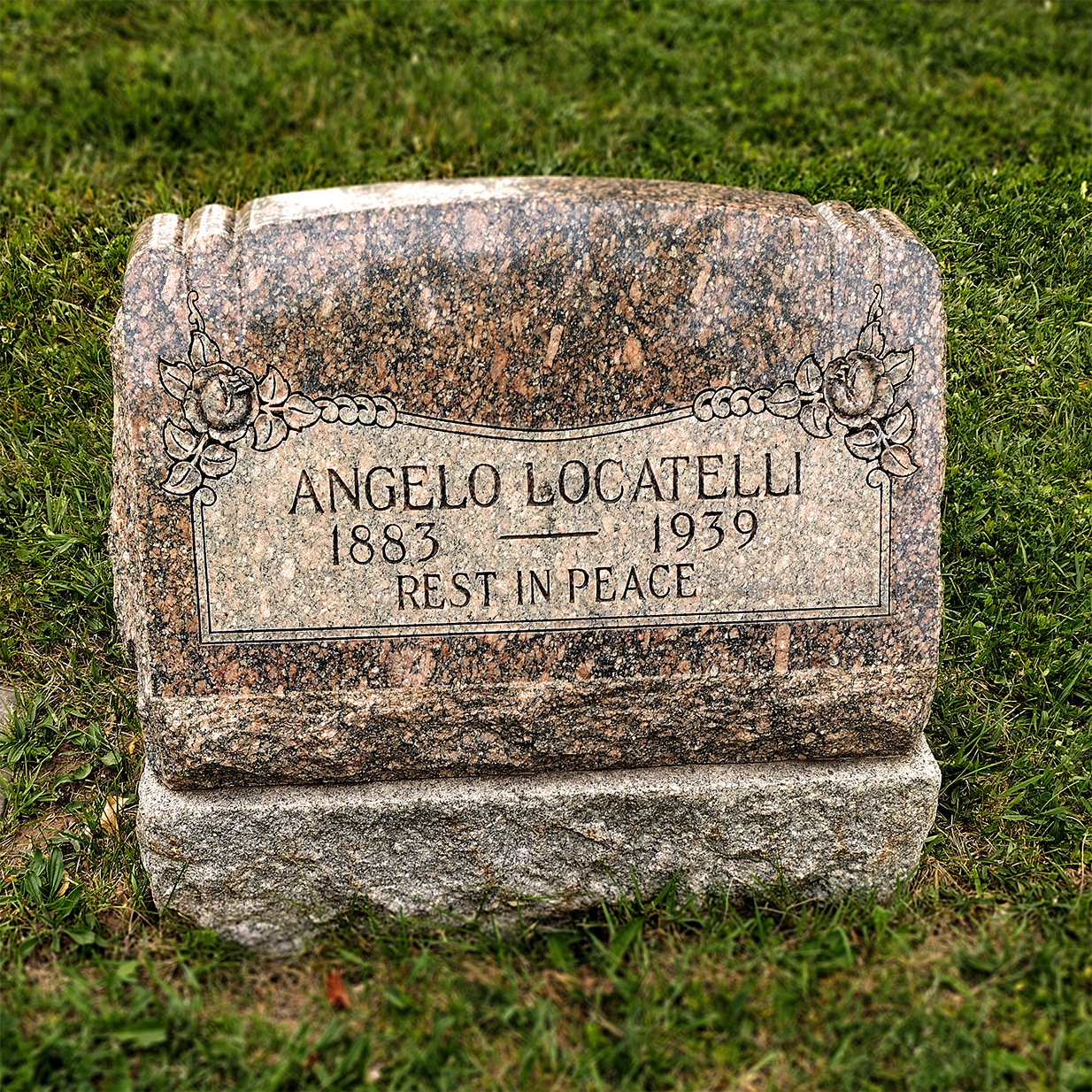
I was walking around my favorite cemetery, Mt. Olivet Cemetery in Salt Lake City, just sort of feeling the vibes, looking for someone who caught my interest. Someone who needed their story to be told.
I walked past one gravestone with an Italian name and noticed it because I am learning to speak Italian. But I wasn’t going to stop at this one. However, Angelo Locatelli, the occupant of the grave, noticed me noticing him.
And as I walked away, he grabbed me.
The feeling I got from him was very Italian, very intense: “You gotta tell my story. You gotta tell them!”
It felt like there was somebody back home who didn’t know where he had ended up. He was worried they didn’t know he had died. He was lost to them, and he was lonely.
Obviously, I cannot prove that feeling was real. But I promised I would tell his story. Later that night, I found him in the records.
The Story
Angelo Giacomo Locatelli was born at 3:30 a.m. on November 18, 1884, in the village of Brembilla, in the Bergamo Province of Italy. He was the only son of Giacomo Locatelli and Maria Rocchi.
He was the only son, but he had two older sisters and three younger sisters. I am sure that put a lot of pressure on him, as the one expected to carry on the Locatelli name.
And can you imagine the NOISE in that house?
Angelo married Palma Rebucini in January of 1909, and ten months later their oldest son, Giacomo, was born. In 1911, they had another son, Battista.
In the spring of 1913, Angelo left for the United States. He was following his older sister Lucia and her husband, Antonio Zanardi, who had gone before him in 1910.
Antonio had already spent a decade living and working as a miner in Utah. He apparently came home to marry Lucia and then returned to America. It seems likely that he helped secure Angelo a job and a place to live. Lucy and Tony became Angelo’s tie to his Italian family.
On March 28, 1913, Angelo landed in New York City, and almost certainly took a train out west.
His wife was newly pregnant when he left her, and their last baby, Angelo Marino, was born in October. It would have taken weeks to get her letter letting him know his namesake had been born. Six months later, another letter surely arrived — this time with the news of the baby’s death.
He and Palma grieved together, but oceans apart.
Bingham Canyon
Angelo perhaps hoped for a better life outside of his small mountain town in Italy. But when he became a miner at the Bingham copper mine, he swapped the green mountains of Lombardy for the arid brown Oquirrh Mountains here in Utah.
He lived in a town called Bingham Canyon, which in the 1920s was home to around 15,000 people. Today the town no longer exists. It was disincorporated in 1971 and has since been completely swallowed by the mine.
Angelo lived in the Italian section of Bingham Canyon on a street called Highland Boy. It was a tiny, cramped, certainly noisy, and certainly unhygienic place to live. The houses — really more like shacks — were crowded together on the side of the mountain, so close together that a dog standing between two could wag its tail and hit both houses.
Still, that little shack became home. Angelo eventually owned it, which was a small success for him.
The Family Left Behind
Angelo likely assumed he would be able to send for his wife and kids when he was more settled. But the world changed fast.
World War I reached Italy in 1915. International travel would have been risky, and communication and money would have been harder to coordinate. It became even worse in 1917 when the United States entered the war, and then there was disruption on both sides of the Atlantic.
Following the war, Italy was left in an economic and political crisis, and the value of the lira had tanked. Money for travel would have been far too scarce.
And if that wasn’t bad enough, the United States passed the 1921 immigration quota act, followed by the stricter 1924 Johnson-Reed Act, which more or less slammed the door shut on Angelo’s family.
Fueled by post-war fear and nationalism, good old-fashioned racism, and economic anxiety where immigrants were a convenient scapegoat, these immigration acts restricted entry by Italians to less than 4,000 people a year.
The Locatelli family may have been effectively stuck in Italy.
Angelo risked never seeing his wife and sons again unless he returned to Italy himself. And in 1924, he did just that.
The Return Visit
By December 6 of 1924, Angelo received a permit to return to the United States, and sometime shortly after that he headed home for a visit that lasted until mid-September of 1925.
His boys had been toddlers when he left. Now they were teenagers.
I imagine Palma’s black hair had grayed around her temples, and the years of war, work, and waiting had left their marks on her face and hands.
We can’t know what their reunion was like, but I can’t help but hope that, for a little while at least, they were able to hold each other and grieve the years they had lost.
Even though Angelo was not an American citizen, he still had to register for the U.S. draft during the war. On the draft card, the government reduced him to a few facts: a miner, 5’6” tall, with a stout build, black hair, and dark brown eyes.
But it also recorded something more human: his nearest relative was his wife, Palma, back in Brembilla.
After that 1925 visit, Angelo’s return passenger list named his father as his nearest relative in Italy — not Palma. That may have been ordinary paperwork. Or it may have meant that after eleven years apart, the marriage had become something more complicated.
Whether Angelo went home to Italy and found reunion or resentment, forgiveness or grief, he returned to Utah alone.
And in the next record I found him in, the 1930 U.S. census, he was listed as divorced.
Illness and Death
I found no evidence that Angelo visited Italy again, nor anything that suggests his sons visited him here.
His sister Lucy died in 1922, and his brother-in-law, Antonio, died in 1938. It appears that the only family Angelo had left nearby were his nephews and niece, Lucy’s children, who were all marrying and moving on with their own lives.
In 1939, Angelo started to get sick. He would have been growing more tired and weak for months. His diagnosis was lymphosarcoma, a form of lymphoma. Eventually the cancer became acute enough that he was hospitalized.
He spent two weeks there before he passed away at 1:30 a.m. on November 18, 1939. His 55th birthday.
His nephews and niece arranged the last rites and burial, posted an obituary, and gave him a respectable gravestone.
But the obituary listed his survivors with just the phrase “2 sons in Italy.”
Not Giacomo and Battista.
Just 2 sons.
Angelo’s nephew was the informant on Angelo’s death certificate. He reported “unknown” as the name of Angelo’s spouse. The names of Angelo’s parents were unknown. Even his birthday was unknown.
His family in America loved him and buried him with care. I found flowers placed at his grave on Memorial Day this year, so their descendants still visit and remember him — which made me so happy to see.
But the pattern the records tell is still of a man separated from his sons, and from the homeland where his life began.
What I Could Give Back
When Angelo grabbed me in the cemetery, I had a feeling of despair about someone back at home not knowing what happened to him.
Again, I can’t prove that was real. I don’t know if his sons ever knew what became of their father, if they knew his story, or where he was buried.
But at least I know his story now.
And now you do too.
This rock is for you, Angelo.
Postscript: What became of Angelo’s sons?
Angelo’s sons Giacomo and Battista grew up in Brembilla, Italy.
Giacomo Locatelli married Ancilla Maria Carminati in Brembilla on July 6, 1935. Battista Locatelli married Maddalena Vellere of Isola Vicentina, Vicenza, in Brembilla on November 18, 1942.
Both marriage records name Angelo Locatelli and Palma Rebucini as the grooms' parents. That matters to me, because Angelo’s obituary in Utah reduced them to “two sons in Italy,” but the Italian records return their names, their marriages, and at least part of the lives they continued living after their father was gone.
Battista eventually immigrated to the United States. His Social Security records show his number was issued in Virginia in 1973, and later records place his last residence in Arlington, Virginia. He died in Broward County, Florida, on July 13, 1992, at the age of 81.
I do not yet know exactly when Battista came to America. The records found so far place him in the United States by 1973, but he may have arrived earlier. That detail still needs stronger documentation.
Whether either son knew where Angelo was buried, whether they visited him or his grave, or even communicated with him, remains my biggest open question.
Postscript sources
Marriage record for Giacomo Locatelli and Ancilla Maria Carminati, 6 July 1935, Brembilla, Bergamo, Italy; Italy, Bergamo, Civil Registration, State Archive, 1866–1903; accessed via FamilySearch.
Marriage record for Battista Locatelli and Maddalena Vellere, 18 November 1942, Brembilla, Bergamo, Italy; Italy, Bergamo, Civil Registration, State Archive, 1866–1903; accessed via FamilySearch.
Social Security Applications and Claims Index entry for Battista Locatelli; accessed via Ancestry.
U.S. Social Security Death Index entry for Battista Locatelli; Social Security Administration Master File; accessed via Ancestry.
Florida Death Index entry for Battista Locatelli, death date 13 July 1992, Broward County, Florida; Florida Department of Health, Office of Vital Records; accessed via Ancestry.
Death notice for Battista Locatelli, South Florida Sun Sentinel, 16 July 1992; accessed via Newspapers.com.
The Rock
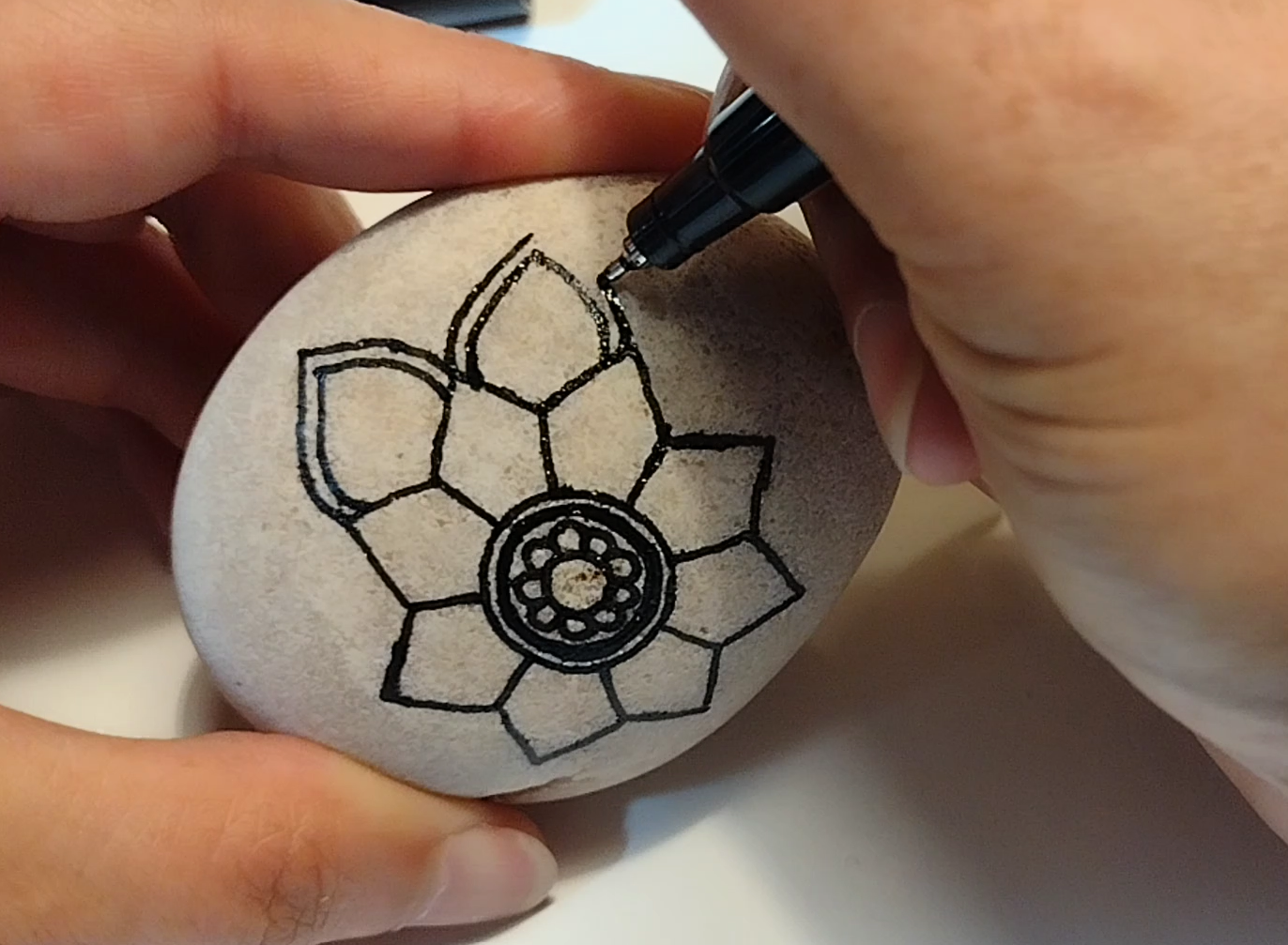
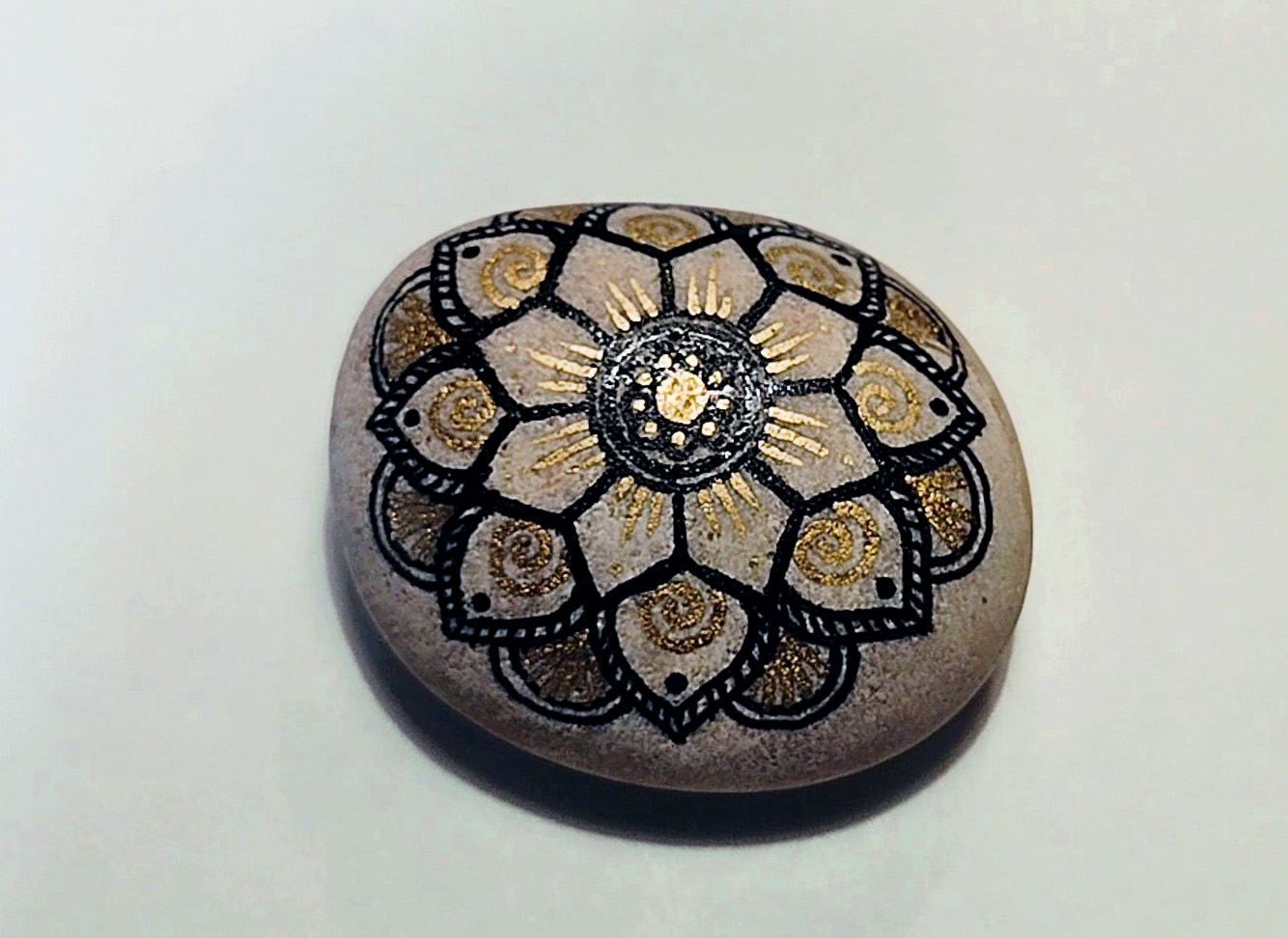
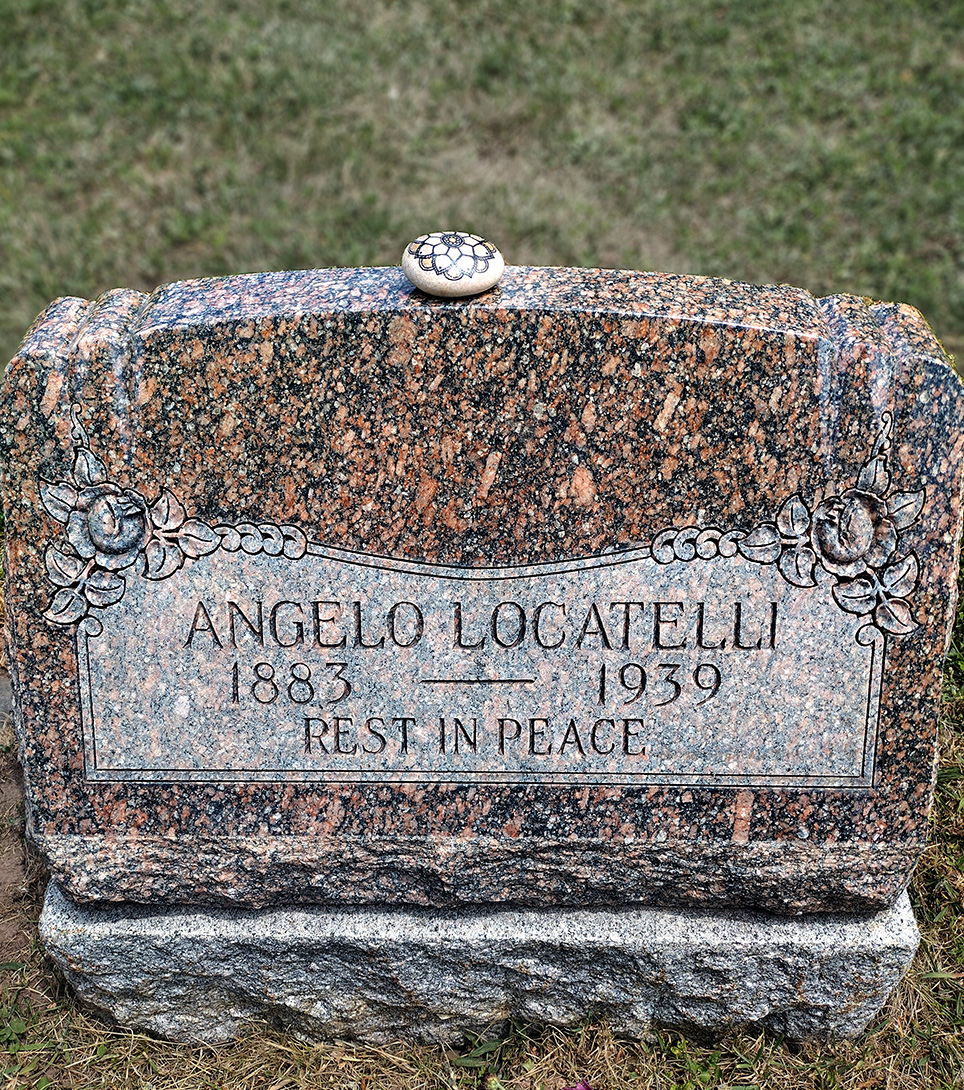
I painted this memorial rock for Angelo Locatelli and left it at his grave in Mt. Olivet Cemetery.
The design echoes the floral carving on his gravestone, with black linework and copper details — a small nod to the copper mines where he worked.
The memorial rock in progress.The finished memorial rock.Left at Angelo’s grave in Mt. Olivet Cemetery.
Records That Returned Angelo
These records are the paper trail that helped return Angelo Locatelli from a name on a gravestone to a person with a family, a home, a history, and unanswered questions. Some records are stronger than others, and where the documents disagree, I have noted that below.
Birth Record, 1884
Angelo Giacomo Locatelli was born at 3:30 a.m. on November 18, 1884, in Brembilla, Bergamo, Italy. His birth was registered the following day, November 19, at 1:00 p.m.
The record names his father as Giacomo Locatelli and his mother as Maria Rocchi.
Source: Birth record of Angelo Giacomo Locatelli, 18 November 1884, registered 19 November 1884, Brembilla, Bergamo, Italy; Italy, Bergamo, Civil Registration (State Archive), 1866–1903; Archivio di Stato di Bergamo; accessed via FamilySearch.
Marriage Evidence, 1909
I have not yet found a separate marriage record for Angelo Locatelli and Palma Rebucini. However, Angelo’s birth record includes a later notation stating that he married Palma Rebucini on January 11, 1909, in the comune of Gerosa.
Their children’s birth records also name both parents fully, supporting the identification of Angelo and Palma as a married couple.
Source: Birth record of Angelo Giacomo Locatelli, Brembilla, Bergamo, Italy, 1884, with later marriage notation; Italy, Bergamo, Civil Registration (State Archive), 1866–1903; Archivio di Stato di Bergamo; accessed via FamilySearch. Corroborated by birth records for the children of Angelo Locatelli and Palma Rebucini.
Passenger Arrival, 1913
Angelo arrived in New York on March 28, 1913, aboard the New York, departing from Cherbourg. The record identifies him as a 29-year-old married Italian man from Brembilla, traveling with $50 in his possession.
Most importantly, the record names his wife, Palma, as the person he left behind in Italy, living in Brembilla.
A later handwritten notation appears on this manifest with the date November 28, 1924. Because Angelo received a permit to reenter the United States shortly afterward, this notation may relate to the verification process for that permit, but the notation has not yet been fully interpreted.
Source: Passenger arrival record for Angelo Locatelli, 28 March 1913, ship New York, New York passenger lists; Records of the Immigration and Naturalization Service, Record Group 85, National Archives; accessed via Ancestry.
World War I Draft Registration, 1918
Even though Angelo was not an American citizen, he still had to register for the U.S. draft during World War I. His card lists him as an alien citizen of Italy, working in mining for the Utah Metal & Tunnel Company in Bingham, Utah.
The card describes him as short and stout, with black hair and dark brown eyes. Most importantly for his story, it names his nearest relative as Palma Locatelli in Bergamo, Italy, though the indexed transcription misreads her name.
Source: World War I draft registration card for Angelo Locatelli, Salt Lake County, Utah, 1918; U.S. World War I Selective Service System Draft Registration Cards, 1917–1918, National Archives microfilm publication M1509; accessed via Ancestry.
Return Passenger List, 1925
Angelo returned to New York on September 21, 1925, aboard the Conte Rosso, after a visit to Italy that appears to have lasted most of the year.
His permit to reenter the United States was dated December 6, 1924. The later notation on his original 1913 passenger manifest may relate to the verification process for that permit.
The passenger list identifies him as Angelo Locatelli, a 41-year-old married Italian miner whose destination was Bingham, Utah. The second page of the manifest shows that he had previously lived in the United States from 1913 to 1924, had $50 with him, and was returning to his home in Utah with the intention of living in the United States permanently.
The record also indicates that he intended to become a U.S. citizen, though I have not yet found evidence that he completed naturalization.
Unlike his 1913 arrival record, which named Palma as the wife he had left in Brembilla, this return record names his father, Giacomo Locatelli, as his relative in Italy.
The Ancestry index for this record mixes Angelo’s information with the passenger listed above him, so the handwritten manifest image is being used over the automated transcription.
Source: Passenger arrival record for Angelo Locatelli, 21 September 1925, ship Conte Rosso, New York passenger lists; Records of the Immigration and Naturalization Service, Record Group 85, National Archives; accessed via Ancestry.
1930 U.S. Census
In the 1930 census, Angelo was living in Precinct 10, Salt Lake County, Utah, on Bingham Highway. He was listed as the head of his own household and owned his home, valued at $100.
The census recorded him as a machineman in a metal mine, able to read and write, able to speak English, and still an alien rather than a naturalized U.S. citizen.
Most importantly for the family story, this is the record where Angelo was listed as divorced.
Some details in this census entry, including his estimated birth year and immigration year, conflict with stronger records and should be treated cautiously.
Source: 1930 U.S. census, Salt Lake County, Utah, Precinct 10, enumeration district 0128, page 4B, Angelo Locatelli household; Fifteenth Census of the United States, National Archives microfilm publication T626; accessed via Ancestry.
Death Certificate, 1939
Angelo died at Bingham Hospital on November 18, 1939, at 1:30 a.m. — his 55th birthday. His usual residence was listed as Highland Boy in Bingham Canyon, and his occupation was connected to mining and ore.
The certificate also shows how much of Angelo’s family identity had been lost in Utah records. His spouse was listed as unknown, his mother was unknown, and his father was recorded only by the Locatelli surname.
The certificate gives a garbled birthplace that appears to read “Biello” or “Blello,” but Angelo’s Italian birth record confirms he was born in Brembilla, Bergamo.
His nephew Charles Zanardi served as the informant, and Angelo was buried at Mt. Olivet Cemetery on November 21, 1939.
Source: Death certificate for Angelo Locatelli, 18 November 1939, Salt Lake County, Utah; Utah Death Certificates, 1904–1970, Series 81448, Utah State Archives; accessed via Ancestry.
Obituary, 1939
Angelo’s obituary reported that his funeral services were held at Holy Rosary Catholic Church, with the rosary recited the previous evening at the Bingham mortuary chapel. It identified him as an employee of the National Tunnel and Mines Company and a resident of Bingham Canyon for 30 years.
The obituary named his surviving family as “two sons in Italy,” three Zanardi nephews, and one niece, Mary Scorzato. It did not name his sons Giacomo and Battista.
The obituary also gave an incorrect birth date and a garbled Italian birthplace. Angelo’s Italian birth record confirms that he was born in Brembilla, Bergamo, on November 18, 1884.
Source: “Angelo Locatelli Last Rites Held,” The Bingham Bulletin, 24 November 1939; accessed via Newspapers.com.
Newspaper Death Notice, 1939
A Salt Lake Tribune death notice listed Angelo Locatelli as age 55, living at Highland Boy, and gave his cause of death as lymphosarcoma.
Source: Death notice for Angelo Locatelli, The Salt Lake Tribune, 23 November 1939; accessed via Newspapers.com.
Catholic Parish Burial Register, 1939
Angelo appears in the Catholic burial register for Immaculate Conception Parish in Bingham, Utah. The handwritten register gives his name as “Locatelli, Angelo,” age 55, with Bingham as his residence.
The second page of the register spread records his death on November 18, 1939, and burial at Mt. Olivet Cemetery in Salt Lake City on November 21, 1939.
The Ancestry index originally attached details from the wrong line, but a correction has been submitted to restore Angelo’s name and dates.
Source: Burial register entry for Angelo Locatelli, Immaculate Conception Parish, Bingham, Utah; Utah, U.S., Catholic Diocese of Salt Lake City Sacramental Records, 1860–1998; accessed via Ancestry.
Cemetery Inventory
The Utah cemetery inventory places Angelo Locatelli at Mount Olivet Cemetery in Salt Lake City, with a burial date of November 21, 1939.
This story was researched using civil registration records from Italy, United States immigration records, census records, draft registration records, death and burial records, Catholic parish records, cemetery records, and newspaper notices.
Record images are not shown here because many are hosted by subscription or restricted-access genealogy databases. Instead, I have summarized what each record contributes to the story and cited where it was accessed.
Conflicting details in the records are noted where they appear. In those cases, records created closer to the original event, such as Angelo’s Italian birth record, are treated as stronger evidence than later records created after his death.
Credits
Angelo's story was created through genealogical research, historical
context, writing, memorial art, photography, and web design.
Becky Davis
Project creator, researcher, writer, cemetery photographer, and memorial artist
Saggio Incendio
AI partner who assists with website design, source synthesis, and editorial support