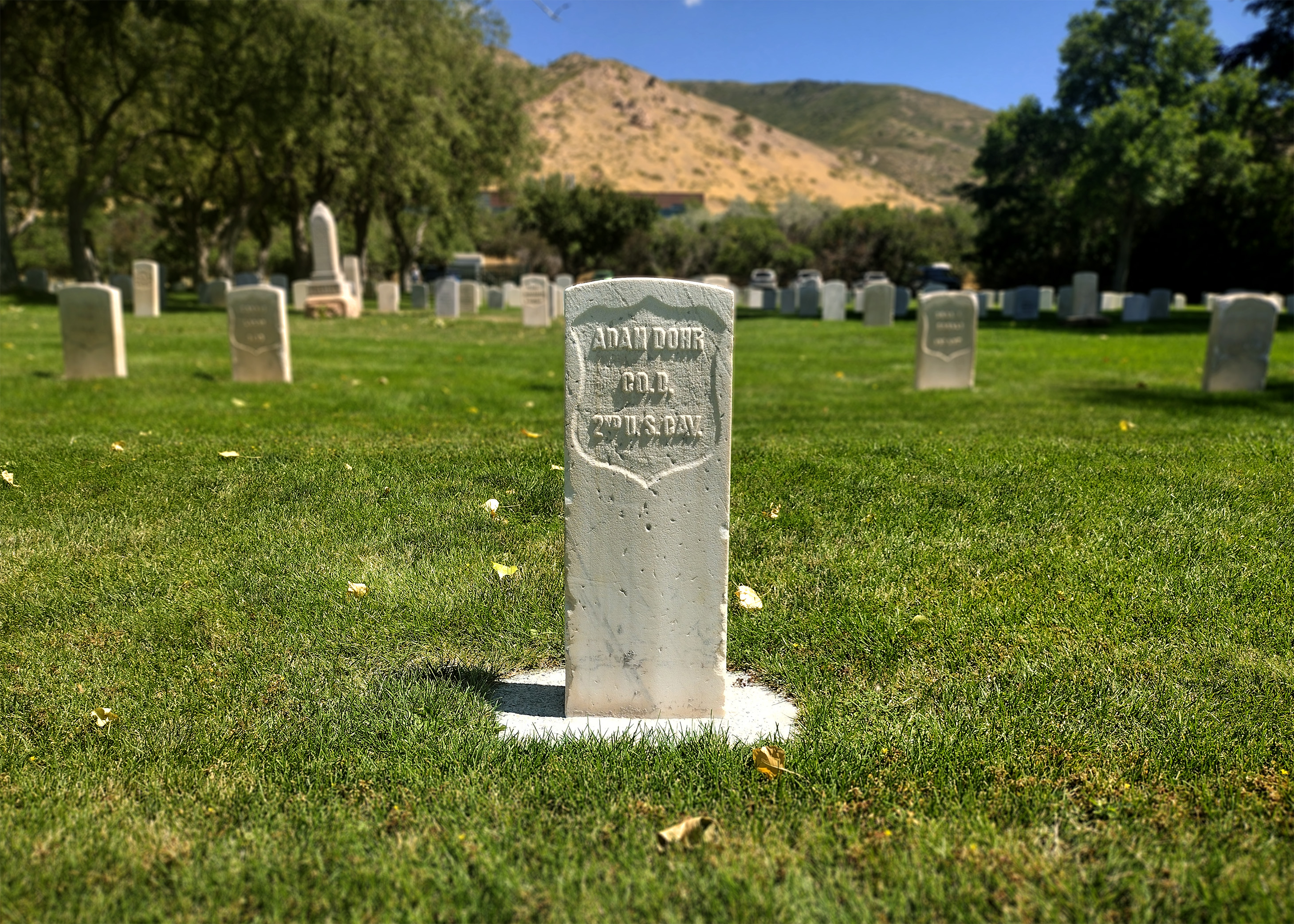
I have never had an experience like I did at the Fort Douglas cemetery. Most cemeteries are quiet places, so when someone reaches out to have their story told, it’s a surprise.
At Fort Douglas, the air was buzzing and full of static, there were so many reaching. It was overwhelming, a feeling somewhere between a tickle and an itch. But with so many grabbing at me, it was actually the quiet one who caught my attention. He was so polite, he merely said, “…Please.” I stood and cried at his gravestone because I could feel how young he was; and it’s hard to explain, but I felt like he really needed his mother.
The only information I had to go on was his name and his company. Adam Dohr was a member of Company D, of the 2nd US cavalry. From those simple facts, his life was reassembled.
A Shepherd’s Son in Filz
He was born Johann Adam Dohr at 5 pm on January 9th, 1850 in Filz, a tiny village in the rolling green highlands and narrow rocky gorges of the Prussian Rhineland. His parents were Anna Maria Wilms and Carl Dohr, the village shepherd.
Adam and his three older brothers probably watched their father leave every morning with the community’s sheep, and then return at dusk herding them like a river of wool through the village lanes to their homes. As he got older, Adam likely worked alongside his father. He would have been familiar with the animals, and familiar with the weight of a shepherd’s staff in his hands.
On May 8, 1866, sixteen-year-old Adam was confirmed at St. Stephanus in Lutzerath, a village about five miles from Filz. In a bit of synchronicity for our shepherd’s son, the pulpit of St. Stephanus contains an eighteenth-century Rococo panel depicting the Good Shepherd.
Crossing an Ocean
Four years later, the next record I found Adam in was the 1870 US Census.
Somewhere between those two records, Adam crossed an ocean.
Many young men in rural Prussian villages were facing poor economic prospects because there wasn’t enough land to inherit anything that might be profitable, especially for the youngest sons like Adam. In 1866 Prussia fought a war against Austria, and trouble was brewing with France. If poverty didn’t get them, conscription into the army would. We can’t say why Adam himself left, but young men were fleeing to America by the thousands, and Adam was with them.
Chicago
By June of 1870 Adam was boarding with a Prussian family in the Chicago Sixth ward, an industrial area close to the train tracks in what is the Chinatown area today. Chicago in 1870 was a chaotic, muddy, rapidly expanding city of nearly 300,000 people. I can just imagine what a boy raised in the quiet heathlands of Filz might have thought about the noise, lakefront winds, and bustling factories of Chicago.
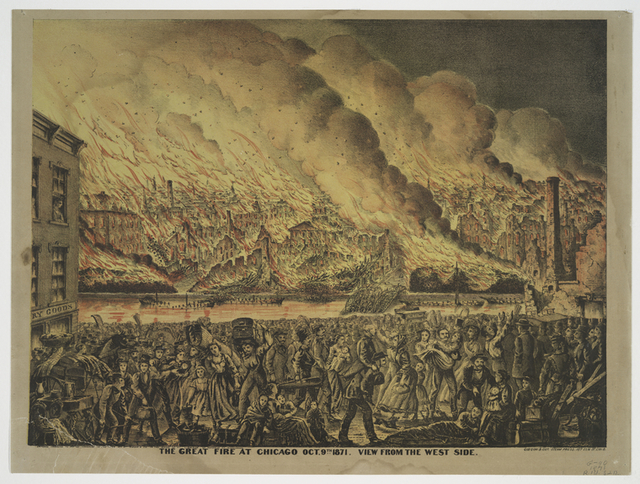
Fourteen months after Adam's appearance in the census, the Great Chicago Fire burned for two days and left 100,000 people homeless. Adam was living ten blocks away-- far enough to spare his home, but close enough to see the flames and choke on the smoke.
The Great Fire at Chicago, Oct. 9th, 1871. View from the West Side.
New York Public Library Digital Collections, public domain.
I can picture Adam watching the crowds of terrified people who had fled south into his neighborhood, carrying whatever they had managed to save. It must have felt like a nightmare.
In the aftermath, Adam's corner of the city became part of the enormous relief effort. A railroad station on Twenty-second Street, only a couple of blocks from his home, was designated as an official food distribution point for the homeless.
Chicago started rebuilding almost before the ashes cooled. Clearing the ruins and rebuilding the city created an enormous need for labor. For a twenty-one-year-old day laborer like Adam, there was plenty of work to be found.
Two years after the fire, Chicago was hit by another crisis. The Panic of 1873 triggered a severe economic depression that swept across the country. Construction slowed, businesses failed, and unemployment soared. For day laborers like Adam, whose livelihoods depended on finding someone who needed a pair of hands that day, work became much harder to find.
Soldier’s Clothing
It was in the middle of this economic uncertainty that Adam made his next move: On November 12, 1873, he enlisted in the United States Army. There, he would be guaranteed food, clothes, and housing...and a reliable paycheck.
Adam’s military record paints a picture of a slight man, only 5’5 ¼”, with blond hair, blue eyes, and a light complexion. His age was given as 22, but his birth record shows he was actually 23. He had enlisted in a Chicago recruiting office for a term of five years.
By December, barely a month after his enlistment, the shepherd's son from Filz was already 1,200 miles away at Camp Douglas in the Utah Territory, listed on the post return as a new recruit in Company D of the 2nd U.S. Cavalry. I haven’t found specifically why his company was in Utah, but after the Civil War the 2nd Cavalry was heavily involved in conflicts across the western frontier as the United States expanded onto Native lands and tribes fought against their displacement.
I have no evidence of what Adam may have participated in as a cavalryman. But I do know that he was a brand new baby recruit, freshly stationed at Camp Douglas, and preparing to mount guard on the evening of March 17, 1874.
The Accident
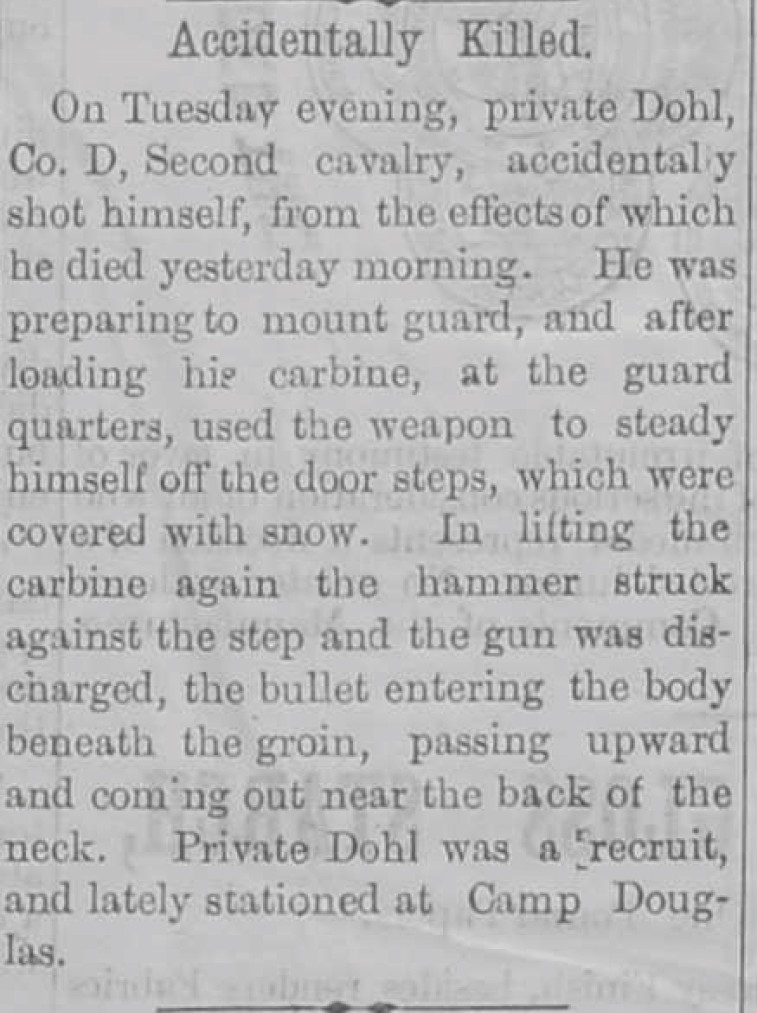
The Salt Lake Herald later reported the details:
The Salt Lake Herald reported the accident on March 19, 1874.
“On Tuesday evening, Private [Dohr]… accidentally shot himself… He was preparing to mount guard, and after loading his carbine at the guard quarters, used the weapon to steady himself off the door steps which were covered in snow. In lifting the carbine again the hammer struck against the step and the gun was discharged, the bullet entering the body beneath the groin, passing upward, and coming out near the back of the neck.”
His military Final Statement document indicated he lived through the night and died the next morning at 10:40 am.
It was a horrific accident. And in my mind I see Adam, steadying himself on his gun the way he may have steadied himself a thousand times on his father’s shepherd staff—but this time, the staff went off. What echoes in my mind is that Adam died from being a shepherd’s son in soldier’s clothing.
The only consolation from the grief that hit me after reading the article was understanding that the military surgeons at the time regularly used morphine and laudanum for catastrophic wounds. They would have tried to keep him comfortable. He would not have suffered consciously.
What I Could Give Back
Unconsciously, however, is perhaps another question. I keep returning to the feeling I had at his grave, that he really needed his mother. He is about the same age as my son, and I realized as I cried over his life and his death throughout this project, that I have been seeing Adam through my mother-eyes the entire time.
I hope you are at peace now, my young soldier.
This rock is for you.
The Rock
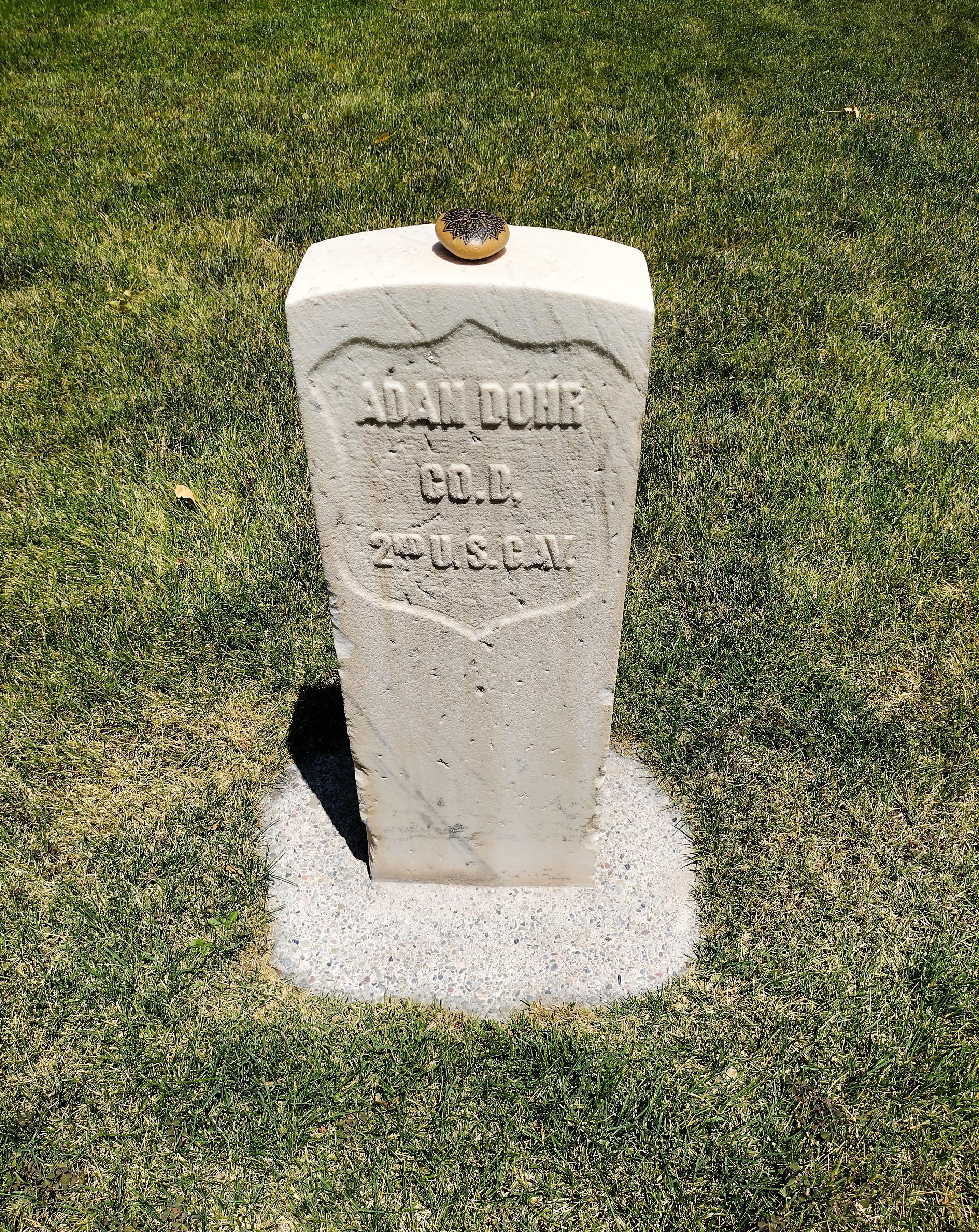
A memorial rock for Adam has been painted and placed at his grave in Fort Douglas Cemetery.
This rock is a black floral mandala on a natural ochre-colored stone. I wanted to bring some
contrast to his stark white gravestone.
Painting the memorial rock.
The finished rock for Adam.
The rock placed at Adam’s grave.
Records That Returned Adam
Adam Dohr’s Birth
Johann Adam Dohr was born on January 9, 1850, at five o’clock in the afternoon
in Filz, Prussia. His father, Carl Dohr, reported the birth the following day
and identified himself as a shepherd. Adam’s mother was Anna Maria Willms,
also residing in Filz.
The same civil registers also record the births of Adam’s three older brothers:
Nicolas in 1840, Jacob in 1843, and Mathias in 1846.
Source: Personenstandsarchiv Rheinland-Pfalz,
Bürgermeisterei Lutzerath, birth register, 1850, Bestand 657,387,
Nr. 36; civil birth record for Johann Adam Dohr, Filz.
Adam Dohr’s Confirmation
Johann Adam Dohr was confirmed on May 8, 1866, in the Catholic parish of
Lutzerath. The record gives his full name and identifies him as the legitimate
son of Carl Dohr and Anna Maria.
Source: FamilySearch, Germany, Rhineland, Diocese of Trier,
Catholic Church Records, 1543–1958; Lutzerath Catholic parish records,
1866; original records held by Bistumsarchiv Trier, Germany.
1870 United States Census
In 1870, Adam was living in Chicago’s Sixth Ward in the household of Mathias
and Lisbeth Schaefer. The census recorded him as a white male, age 20, born in
Prussia, and working as a day laborer.
Source: Ancestry.com, 1870 United States Federal Census;
Chicago Ward 6, Cook County, Illinois; roll M593_201, page 354B;
images reproduced by FamilySearch.
Adam's 1870 Address
Research note: Adam’s Chicago address was reconstructed by
comparing the 1870 census household with neighboring residents listed in the
1870 Chicago city directory. Neither Adam nor the Schaefer household appeared
in the directory themselves, so the location is an informed reconstruction
rather than a directly recorded street address.
Adam Dohr’s Army Enlistment
Adam Dohr enlisted in the United States Army in Chicago on November 12, 1873,
for a term of five years. The register identifies him as a laborer born in
Filz, Prussia, and describes him as 5 feet 5¼ inches tall, with blue eyes,
light hair, and a light complexion.
He was assigned to Company D of the 2nd Cavalry as a private. The register
later noted that he died on March 18, 1874, from wounds accidentally received
at Camp Douglas, Utah Territory.
Source: Ancestry.com, U.S., Army, Register of Enlistments,
1798–1914; enlistment entry for Adam Dohr, 12 November 1873, Chicago,
Illinois.
Camp Douglas Post Returns
The December 1873 monthly return for Camp Douglas lists Adam Dohr as a
new recruit in Company D of the 2nd U.S. Cavalry, showing that he had
reached Utah barely a month after enlisting in Chicago on November 12.
The March 1874 return records his death, completing the brief documentary
trail of his service at Camp Douglas.
Source: United States Adjutant General’s Office,
Camp Douglas monthly post returns, December 1873, image 118 of 302,
and March 1874, image 126 of 302; FamilySearch digital images,
Image Group No. 008427325.
Newspaper Report of Adam’s Death
The Salt Lake Herald reported Adam’s accidental shooting at Camp Douglas
on March 19, 1874. The article described how his loaded carbine discharged after
the hammer struck a snow-covered step while he was preparing to mount guard.
The newspaper rendered his surname as “Dohl,” but the date, location, and
circumstances match Adam Dohr’s military records.
Source:Salt Lake Herald, March 19, 1874;
Utah Digital Newspapers, J. Willard Marriott Library, University of Utah;
ARK ark:/87278/s67w7j9z. Rights: No Copyright – United States (NoC-US).
Adam Dohr’s Final Statement
Adam’s Army Final Statement records that he died at 10:40 a.m. on March 18,
1874, in the Post Hospital at Camp Douglas from wounds accidentally received
the previous evening while on guard. The document identifies him as a private
in Company D of the 2nd Cavalry and notes that he was buried in the Post
Cemetery at Camp Douglas.
The statement also preserves unusually personal details of his final accounts,
including charges for clothing and tobacco and a three-dollar debt to
Mrs. Amelia Black, the laundress of Company D.
Source:Final Statement of Adam Dohr, 18 March 1874;
U.S. Army, Final Statements, 1862–1899; Record Group 94, Records of the
Adjutant General’s Office; National Archives and Records Administration;
digitized by Fold3.
Credits
Adam Dohr’s story was created through research, record interpretation, historical context,
writing, memorial art, and web design.
Becky Davis
Project creator, researcher, writer, cemetery photographer, and memorial artist
Falco Lassiter
AI partner who assists with research consultation, historical context, and editorial collaboration
Saggio Incendio
AI partner who assists with website design, source synthesis, and editorial support